
It was a rain day on the Great Foundation and Screen Porch Project. No work. Sigh. Boy, the fits and starts of this thing. Supposed to rain tomorrow, too, so we shall see.
That at least gave me the chance to get my rusty self back to the art table.
I was going to draw a dog-as-pope.

… although I thought this hound had more papal majesty.
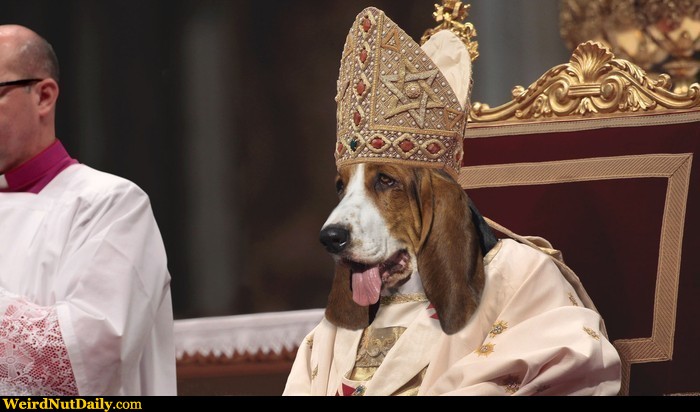
While looking for a good canine pontiff, I — for reasons unknown — found a doggie bantito mixed in with the pope images.

Rather liked that guy. I suppose that image is politically incorrect, culturally insensitive, yada yada. But who’s going to argue with anybody who looks like that?
Then … I ran across the medieval French legend of St. Guinefort, the martyred greyhound. (Which probably began as an East Indian legend involving a martyred mongoose. And isn’t that just the way these things go?)
St. Guinefort, the noble protector of children, unjustly martyred after his heroism, was not merely a legend, but apparently a localized cult within the Catholic church. Belief in the canine saint persisted into the twentieth century. The cult survived repeated condemnations by church authorities, but apparently only succumbed to world wars and perhaps just general modernization.
But really. Who better to be a saint than a dog? If there’s a shred of heavenly justice, there’ll be more dogs than humans up there.
Here’s another telling of Guinefort’s story. This one by a nun with a sense of humor, but who Doesn’t Approve of unauthorized doggie sainthood.
Moving right along …
That quest also led me down a rabbit hole of other saintly trivia. Did you know that (the former, if you’re Roman Catholic) St. Christopher was believed to have had the head of a dog until his alleged encounter with Jesus? See? That’s Christopher, not Guinefort the Greyhound, below. Man, I’ll bet that sight scared the heck out of the Baby Jesus when he met (even though, as of the 1960s, he probably no longer did meet, if you’re Roman Catholic) Christopher on the road.*
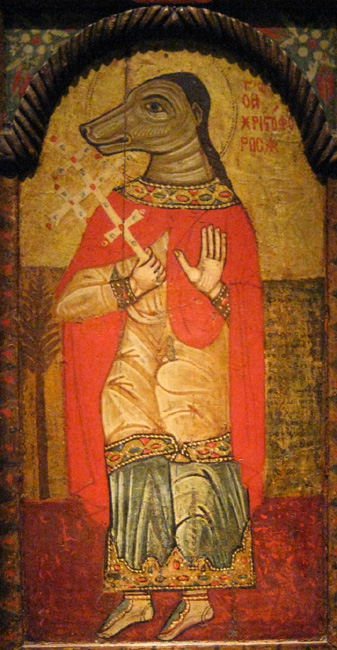
NOW we get to St. Guinefort, the dog picture.

I really only did this one to test out some new gold metallic acrylic paint I got last week. I wanted to see if it was really, really metallic. And by golly, as you see, it is.
This being a folk legend, I treated it as folk art. I’m pleased with the design, the colors, the dead snake (see the story, linked), the gold paint, and the pose and character of the greyhound, but man it’s a headbanger for me trying to model shapes with light and shadow. The painting on the dog sucks. Oh well. I told myself I’d blog anything good enough to finish, so I’m blogging it.
Mixed media (acrylic and graphite pencil) on a 6×8″ gessoed wooden plaque.
—–
*Or something like that. But most likely not; as Wikipedia notes, Christopher’s encounter with Jesus seems to have been borrowed from Jason — of Argonaut fame — and his similar good deed for the goddess Hera. These things do get complicated, don’t they?
Etienne de Bourbon, an inquisitor reporting from Dombes, north of Lyon (a small area now straddling the railway-line in the “departement of the Ain” between Lyon and Bourg-en-Bresse), recorded the above account in his 13th century narrative supporting Guinefort’s designation as a heretic. He had the dog “disinterred, and the sacred wood cut down and burnt, along with the remains of the dog.” Apparently a dog cannot be an official saint, though he can be an official heretic.
Medieval pecksniff.
LOVE the dog’s expression.
“I kill the snake, save the kid’s life, and get shot. Then I get buried with honors, but some Inquisitor comes along and digs me up and burns me. And people who Like me get burned at the stake. Damn!”
I like the entire painting, shadows and all. It presents Guinefort in a noble, undramatic manner which lends dignity to both the dog and the folktale. I can’t speak for the mixed media (it’s probably more apparent in the painting itself than in the photo we see), but the halo does make the “icon” aspect stand out, and that’s probably due to the metallic effect.
Medieval Catholicism always leaves me scratching my head. “You did what to whom? Because why? WTF?” St. Joel the Philosophically Pure says, “If you find yourselves burning one another to death over belief structures that aren’t really harming anybody else, stop. You’re doing something wrong.”
And yet modern American atheists are no more logical. You have to worry about dressing a dog up like the Frito Bandito, because somebody might be loudly offended. But putting a dog’s head on the freakin’ Pope is fine and dandy? You kids today. We had different standards for giving offense back in the 13th century, I can tell you.
Oh, and also I need that dog icon. You selling any of those?
Not Medieval, but Larry the Philosophically Pragmatic always remembers Henry VIII, who for strictly political reasons invented the Church of England out of the “Divine Right of Kings” premise, and spent the rest of his life executing both people who were too Catholic, and people who were too Protestant, according to his Anglican rules.
Every time the Church gets into politics, it ends badly. Very badly. Yet I have friends who desperately want to fix what’s wrong with the U.S. by “returning” to Christian Government.
Oh, and I had an uncle whose human face always reminded me of a Boxer. People see what they want to see, then along the grapevine “looks like” becomes “has.”
My wife’s family was French Huguenots so French Catholic’s have always had a special meaning to them.
I’ve never been much for canonization but must say that you’ve captured that essence of canine, saintly grace.
Caninization? (ducks)
Popular sanctity cults like that were a significant feature of the Western Church for fifteen hundred years, only really scrubbed out during the Counter-Reformation. It took the Crown nearly four hundred years to eliminate the popular veneration of Simon de Montfort, for instance, and even longer to eliminate the similar popular sanctification if Llewelyn Fawr and Dafydd ap Gruffydd- the last two of the great Welsh princes. Governments and their allies within the Church disliked popular cults of this kind because they distinctly tended towards anti-authoritarian, someimes even anti-clerical, morae- even today, the popular Roma/Romany devotion to The Black Madonna is a source of considerable friction in religiously conservative areas of France and Spain.
“Popular sanctity cults like that were a significant feature of the Western Church for fifteen hundred years”
Fascinating stuff, E. Garrett Perry! I knew vaguely about such things, but never had reason to think about them until I ran across Guinefort.
When I was a kid, I had a whole list of private “saints,” and you can bet they tended toward anti-authoritarian. 🙂