
Gassed it up and filled it with oil today. Read the manual, turned all the right dials, flipped all the right switches, pulled the cord and we were in business.
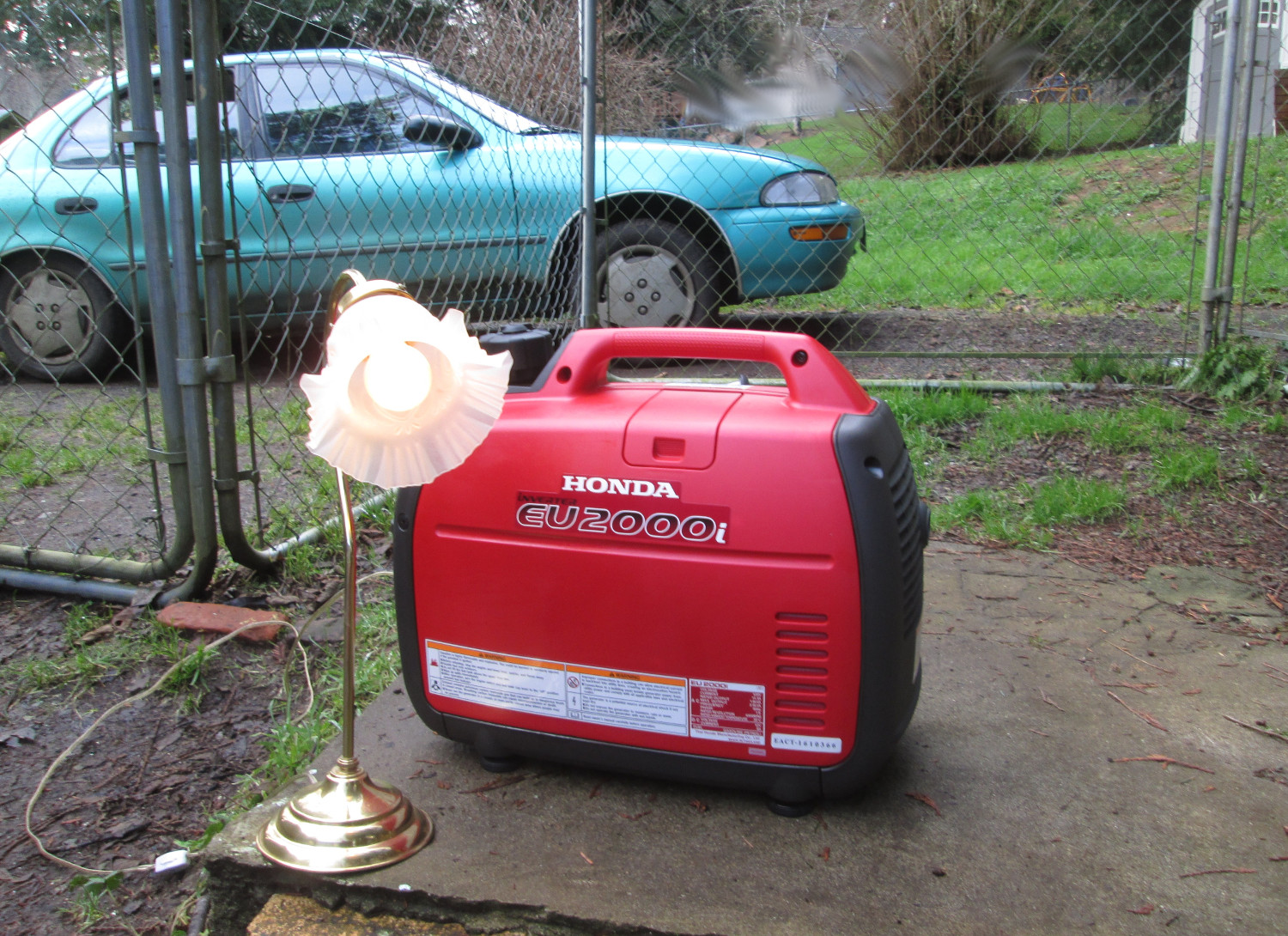
This is the new generator under its very first load. (And no, I’m not really into froufrou lamps, but that one belonged to my friend Jill who died three years ago.)
And this incredibly exciting photo (well, incredibly exciting to me, not that I’d expect anyone else to notice) is the new generator running both the refrigerator and a small chest freezer at the same time. I wasn’t sure it could do that, but neither the appliances nor the generator objected. Those two appliances are what matter most.
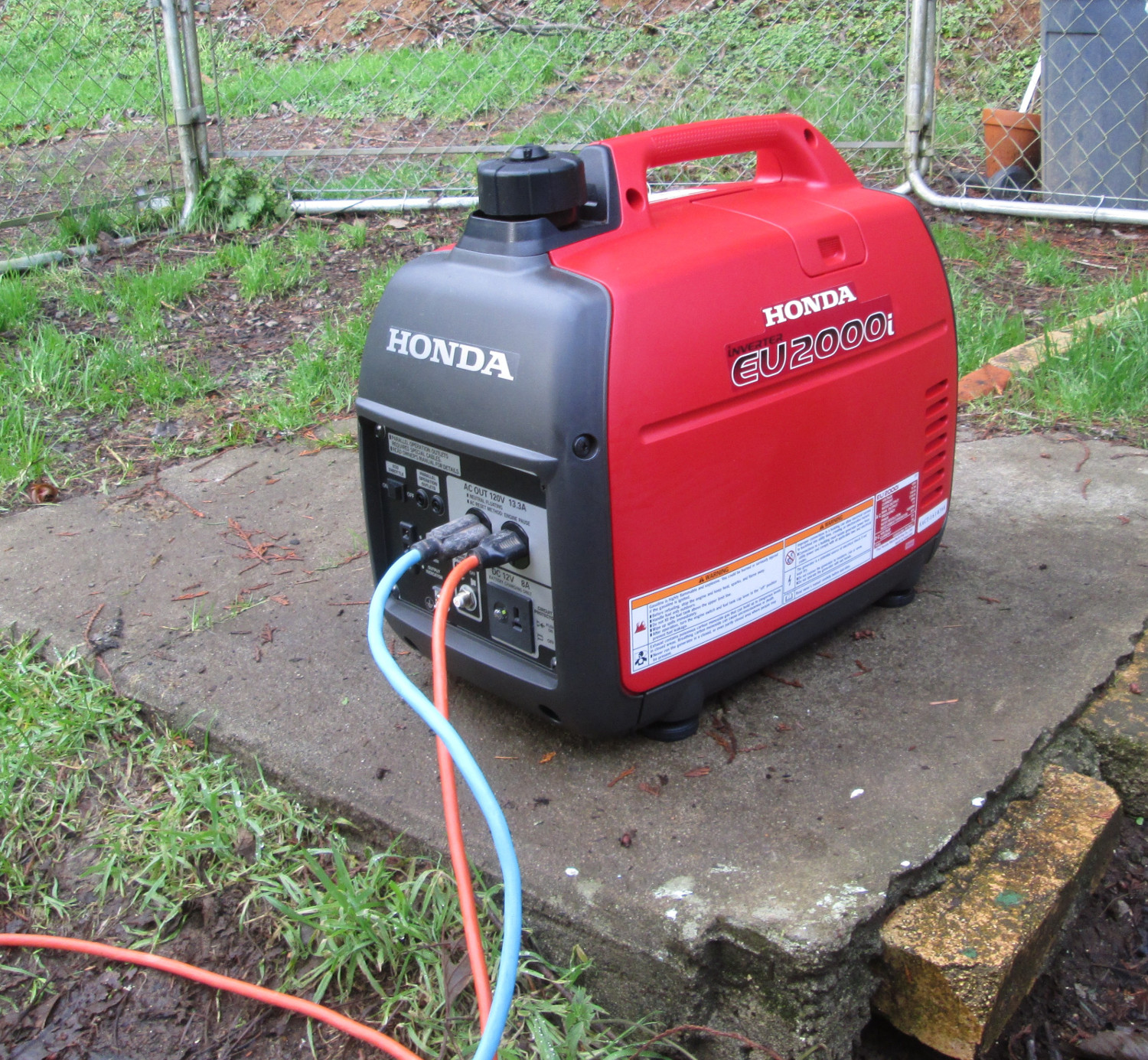
It took seven or eight pulls to get the first crank. New equipment, I expected that. After I disconnected the appliances, shut the generator off, and restarted it, it took one pull only.
I tell you, guys, this is better than getting my first bicycle the Christmas I was 10. Definitely a bigger surprise, too. 🙂
Good way to start the new year, Claire. I’m happy for you. Checking off one more item on your survival “bucket list” is always a good feeling.
Thanks, Pat. And that was a big item, checked off the list in a very big way. Of course, no preps are ever finished. But that was the only big item I was waking up at night worrying about. Then to get not only a generator but that generator. Whoohoo!
Excellent!
Remember about emptying it completely before storage, because really that’s the most important thing about getting it to start *after* storage. Not just the tank, the carb. (Sorry, but I worked in a small engine shop and I’ve seen good ones ruined.)
Is that Big Blue I see in the background? How’s it running now?
I have 2 Honda’s; 1000 and a 3000esi. Love them both. One pull start after sitting for 6+ months. Make sure to drain the fuel (ethanol problems) if you are not using it monthly. (I run mine dry.)
Good job. Hopefully like insurance and you never need to use it.
Congratulations. (Partial) freedom from the grid, or at least some of its failures.
IIRC, you mentioned that you do not have a sheltered place to run it when necessary. A couple pieces of plywood (or even OSB, but OSB doesn’t resist rain as well as plywood), cut a 4X8 sheet in half, lumberyards will discount sheets that have damaged edges, and join the halves with a couple cheap hinges. Makes a cheap, handy A-frame cover to set over the generator and folds flat for storage against a wall. The Deluxe version has plastic (or something) over the gap at the top pf the A…
Forgot to add “the 4X4 folded-together halves also make a handy table when set on sawhorses, and unfolded on a pair of 2X4s set across the saw horses makes a large work table.”
Joel — Advice from somebody who had to cuss over far too many abused small engines. Much appreciated! Yes, that’s Old Blue — who has been running great since her December repair. It’s such a blessing when a mechanic actually gets both the diagnosis and the repair right! Ignition coil and valve cover gasket did the trick.
Arthur Murray — Great suggestions, as usual. For the moment, I have a couple of old solid-core doors + sawhorses I can place the generator on and under. But I like the plywood A-frame idea.
And yep, insurance. I hope never to have to use it, but if I do it’ll surely (at the very least) save a freezer full of food and enable me to write while the power’s down.
Great news Claire! I use fuel stabilizer in my gas for my generator. When done using it turn off the gas supply valve and let the fuel in the carb run dry ( let it run till it stops). This way you protect the carb and have it fueled for quick deployment.
midwestmike — Fuel stabilizer, definitely. I’m still learning about ways to drain the carb (back to the manual!). Your trick sounds easy, which of course appeals. But can that be good for the motor?
Politely cautious disagreement on the A-frame protection while running thing: Air-cooled engines need lots of airflow but not much protection from the elements while running. Probably an open-ended a-frame wouldn’t harm anything, but I’ve seen cheaper generators with Briggs & Stratton engines overheat to the point of valve seizure just from running inside a carport. The one problem I have with little enclosed generators like the Honda is that they do tend to run hot. I’m skeptical of anything that reduces their available airflow in any way further.
Frankly, most of the noise-reduction schemes you can find on the Internet will kill any generator with an air-cooled engine.
Just a thought, nothing dogmatic…
I’m still learning about ways to drain the carb (back to the manual!)
If you have a fuel shut-off valve (I don’t know if the Honda does or not,) just close it and let the engine run until it stalls for lack of fuel. Very simple, no tools or hassle. Won’t harm the engine.
I don’t specifically see a fuel shut-off valve. There is an engine shut-off (which stops the gen. instantly) and a vent on the gas cap that can be opened and closed. I don’t think these are what you have in mind.
There is a carburetor drain screw, however, which seems easy enough to use even though it’s inside the maintenance panel.
The manual gives four different levels of prepping for storage, depending on how long you intend to store the generator. None of them seem terribly difficult.
Good choice, Claire!
“Good choice, Claire!”
Yep, especially given that it was chosen for me (albeit by somebody who knows me well and must have stored that bit of my wish list in his memory files years ago).
Another way to not leave gas in it when storing is to only add a cup or two at a time while using it. See how long it runs on 1 cup, then you’ll know how much gas to add to run the gen long enough to keep the fridge/freezer cold. And congrats on getting the generator. I know it’s peace of mind, even if it’s never needed.
You’re going to love the generator. Like I mentioned in another post, I’ve had mine for close to ten years with no issues other than the routine oil changes. I do two oil changes per year even though I don’t put that many hours on it. Before warm weather starts, I put the heavier oil in and before cold weather hunting season begins, I put the light oil in. That 6am start in single digit temps is tough with heavier oil as the oil pressure cut off switch keeps killing the engine until the oil warms enough to circulate and keep pressure up. I’m not too diligent on draining gas when not in use or searching out non alcohol gas stations for that matter. I just use whatever I have handy and so far there haven’t been any problems. When the last hunting trip is done in November, I fill the tank, add a little Stabil or Sea Foam, whichever is handy, run it for five minutes and put it away. Barring (sp?) power outages where it gets pressed into service, I usually don’t use it again until April or May. After setting for four or five months, it may take three or four pulls to get started. I don’t even worry about keeping the rain off it during operation. It has an excellent case that appears completely weather proof. Give it just a little consideration and it will last for many years.
Joel – The ON/OFF switch (knob, actually) on the EU2000 shuts down the engine electrically AND closes the fuel tank outlet valve. The proper way to store one is shut it down, let it cool, open the side cover, the carb wil be on the left, about 10AM in the opening. On the bottom of the float bowl is what looks like a square or hexagonal metal extension, about 1/2 inch long, with a screw in it. This is the float bowl drain screw, There should be a clear rubber tube about 1/4 inch in diameter connected to the bowl extension which goes through the bottom of the plastic generator case and extends below the case about an inch (this prevents drained fuel from winding up inside the plastic case). When the drain screw is opened (lefty loosy, righty tighty) about 2 turns one should see fuel flowing through the drain tube. Give it 30 seconds or so and close the screw, the bowl is now empty. There will still be some residual fuel in the carburetor main jet which extends into the bowl to pick fuel up during operation. To clear this very small mount of fuel – it’s still enough to “varnish up” when it dries out and clog the jet – leave the ON/OFF switch in the OFF position, turn the choke to ON and pull the starter through a few times. The vacuum in the intake system will draw what’s left of the fuel through the jets into the intake manifold where it won’t cause carb problems (same trick works on any reciprocating internal combustion engine as long as it has a fuel shutoff valve).
PRO TIP: About loosening that drain screw – it’s very worthwhile to get into the habit of NOT leaving any screws loose. I’ve seen people drain the carb and not re-tighten the drain screw, which leads to fuel all over the ground when the tank is filled the next time. I was trained right at the outset that if there’s a bolt, nut or screw anywhere on an engine, vehicle or airframe it is properly tightened to the correct torque value, nothing left “finger tight” to tighten later. It gets properly tightened right now (and safety wired if applicable) or is taken off to be properly reinstalled later. That prevents wings or engine cowlings from “departing in flight” which is a bit more serious than leaking fuel (I have seen engines grenade from a mechanic failing to properly torque ALL the rod bolts because he was distracted during the process and lost his place; he should have removed all of ’em and started over. Checklists are great, following proper procedures each and every time is much more betterer. ).
As for the EU2000 overheating, possible, but I’ve never seen it. The 2000 has an internal cooling fan, vanes on a flywheel-mounted ring. Yes, that’s just like every air cooled engine ever made for stationary equipment, but the vanes on the 2000 are proportionally much larger for engine size than what one finds on Briggs or Techumseh engines. If you put your hand near the louvers at the exhaust end of the 2000 you can feel the cooling air exiting (watch out for the muffler outlet through the louvers, it’s hot). The EU3000 even has its own set of cooling exit louvers, between the exhaust outlet and the top cover, and the quiet 5500 is just a bigger 3000. Honda did their homework on these things. I’d certainly recommend never restricting cooling air in any way, but an open ended 4 ft A-frame with the exhaust pointing out and the other end completely open won’t hurt it, and keeping rain off the electrical connections is a good idea. I get a little antsy when water and volts start fraternizing.
Buy only no-alcohol fuel for the small engines. Put in the stabilizer before you leave home so the gas pump mixes it for you. 300:1 mix of synthetic snowmobile oil helps with cranking and extends life of rings and cylinder bore.
Our double-wide-with-drawers-deluxe fridge draws 100W running and 400W when it defrosts from our kitchen solar system. Not so much, but it is relentless (80% on 20% off) and has a bad habit of defrosting after sundown.
If you have good wind and mechanical hobbyist types available see http://www.otherpower.com. I have stockpiled magnets for building these generators but wind sux at home and ‘farm’.
I don’t think I’d worry too much about running a Honda out in the elements, but a plywood A-frame should reduce the noise significantly. Larken Rose’s doppelganger did a video on it: https://www.youtube.com/watch?v=5zwc5mdEbDI
In this one he demonstrates the gas cap hack to attach a gas can: https://www.youtube.com/watch?v=RDkL593Wbt0
I’ll second cm1’s recommendation, it is worth it to find non ethanol gas for the generator, even with out fuel stabilizer it store much better than ethanol much less chance of a ruined crab if you forget to drain the fuel.
Lovely piece of equipment. I bought an old used one that looked like it fell off the back of a truck, then got dragged down the highway for 1500 miles. Drained some sparkly oil out, then proceeded to use it 10+ hours a day for more than a week. Utterly perfect performance, hated to sell it but my need for it passed… and I made $20 on the resale.
Some people just have no clue what these little gems are, or what they are not.