
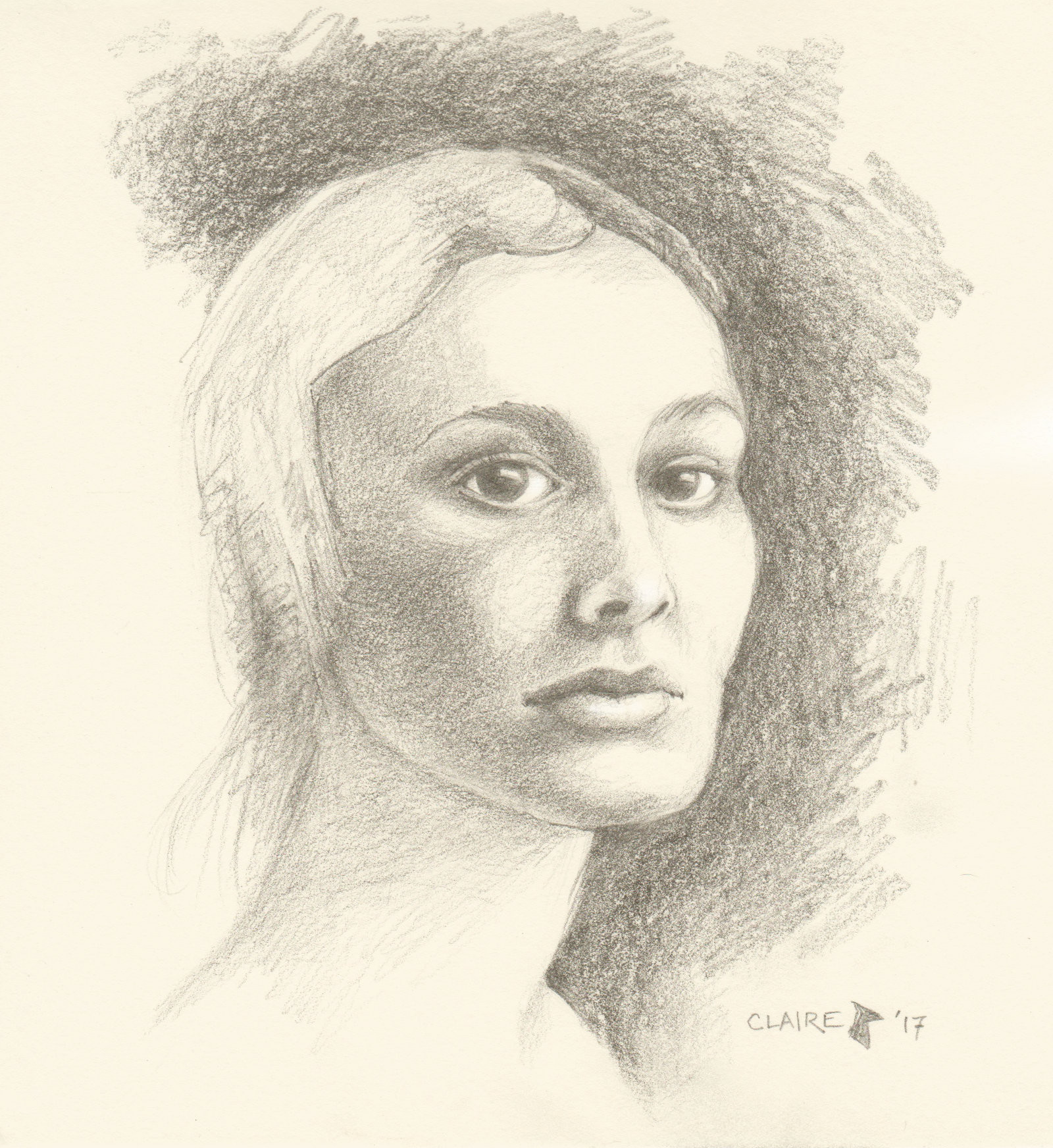
I never could draw.
I took illustration classes for a while. Long, long time ago. Among students who hoped to become professional illustrators and other students who had no hope, I was in between. Some things I could do well. I always had a decent sense of color and design. But drawing? Meh. I’d observe the elegance of line, the flair, the ease, the confidence and powers of observation of the best students in the class and want to curl up in a little ball.
Oddly, there was one type of sketching at which I excelled. In figure drawing class, we’d usually begin with 30-second exercises — gesture drawings to capture the essence of a pose. Swoop, swoop — indicate the model’s pose in a few rapid lines. Then the model shifts and it’s swoop, swoop for another 30. At these, I was the class champ. (Not that we were competing with each other; but of course we were competing even as we admired and encouraged each other. We competed for our beloved teacher’s esteem, too.)
Then we’d move on to 60-second drawings. Then two-minute drawings. Finally we’d settle in to work on one long pose for the rest of the session.
By the time we got to two minutes I was already starting to mess up. Because that was long enough to think about what I was doing. And thinking meant worrying and losing confidence.
—–
There was another student in my classes, Caroline, who was in similar straits. Her problems came not in live drawing classes, but when we actually had to plan and execute an illustration. Caroline’s rough sketches were brilliant. Playful, strong, confident, original. Then once she’d decide on her design and begin painting … flubb.
She wasn’t bad. In fact, she was quite talented. Even with her weaknesses her stuff certainly ranked in the top 10 in our classes. She’d just tighten up. The play and magic would depart. The woman who could have been a terrific illustrator became a merely competent one.
Caroline was an uppercrust southern girl. Not rich. But let’s say born and bred to the executive class. And back then, a proper southern young lady was expected to be a charming hostess, an ornament to her husband, a good conversationalist, a helpful volunteer, a mother — and not much more.
Caroline was between two worlds.
On one hand, she had prevailed upon her family to send her thousands of miles away to a school that not only taught art (which would have been acceptable for her to dabble in as a pasttime) but taught art as a vocation. Only a handful of its certificate holders would actually have the right stuff to earn their livings as artists, but this was definitely a vocational school.
On the other hand, after relocating, she had married a parentally approved man, an ambitious young executive at a famous company, who bought into her parents’ expectations for her 100 percent. He considered her art to be a waste of time and a distraction from him and from her main job of being his attractive and poised executive wife.
She didn’t talk about him that much, but all of us who ever came close to Caroline knew she was being ripped in two.
I met the husband once. It was at a student exhibit where all of us were able to hang five or six pieces of our work and invite family to see. I walked up behind Caroline and her husband as they were viewing her illustrations.
“This is complete garbage,” he was informing her authoritatively (and oh so constructively). That’s all I heard. I never did introduce myself or get an introduction to him.
“It is NOT garbage,” I thundered from behind. I proceeded to point out the many good aspects of Caroline’s work. I don’t recall how he reacted. I didn’t care. I don’t care. I just knew he was sabotaging a talented and already struggling young woman. And to hell with that.
Of all the people I attended that school with, Caroline is one of the three I most wonder about today. The other two were top-top-top talents who disappeared into obscurity when they should have been among the few to make it. One was an awesome artist but an odd duck, painfully shy and humble. I heard he later retreated into mental illness and agoraphobic reclusion. The other was a girl from a very traditional Chinese family. She had a blazing talent and was the school’s #1 undisputed star. Why I never heard of her after she graduated I’ll never know. I still look her up once in a while, hoping to see her illustrating children’s books or something. Not a word about her anywhere.
Caroline, I suspect, probably ended up allowing upbringing and expectations to crush her. Maybe she gave up art, then 10 years later divorced the nasty husband and became an angry feminist, seething with resentment for what she’d lost. I don’t know. I just wonder about her. I hope she overcame all those crushing familial and cultural expectations but I’m guessing she didn’t have enough belief in her talent to fight for it.
—–
I didn’t have enough belief in my talent to fight for it. My reasons were different than Caroline’s. About as different as could be. I didn’t have to fight family expectations (except in a bassackwards sense). I had to fight me and my own lack of belief in myself. I had to fight my perception (correct, yet still wrong) that I was painfully mediocre. I didn’t have what it took to fight that fight.
I’ve told bits of this story before, so bear with me if you recall it. But now that I’m doing art again, it needs repeating.
My familial expectation was that I would be an artist. Not only would I be an artist, but that I would be the artist. As I’ve mentioned, Mom’s family cherished a myth that their previous generations or peripheral connections had produced world-renowned or at least nationally known artists in several fields. Whether true or not, I don’t know. They could name the names (and the artists were indeed renowned). They could not trace the specific connections. But it was certainly true that Mom and her brothers and sisters all had a smattering of art talent. As children of the Great Depression, they never had the luxury of developing their abilities. So they looked to my generation to produce the next luminous name to add to the family legend.
Gradually, my whole generation disappointed them. Gradually, I became the only one who showed both a hint of ability and a willingness to follow through on it. Gradually, the hopes of my multitude of aunts and uncles fell on me.
To make matters worse, in the chaos that was my immediate family, I developed the impression that my abilities with writing and drawing were about the only thing that gave me any value. Otherwise, I was pretty much a smear of shit on everybody else’s shoes.
And — in one of the stupidest errors of my life — I believed that talent was either something you had or something you didn’t. It wasn’t something you could grow, said my ignorance, laziness, and self-loathing. So when I wasn’t instantly the most brilliant artist in the room (and I never was when I was among “real” artists) … well, I felt the burden growing heavier. Until it finally became unbearable.
The more I worked at art, the more mediocre I felt. The more mediocre I felt, the more mediocre I became. I choked. I quit school. For decades, I couldn’t do art at all.
I only regained the ability to do art again 11 years ago after reading Julia Cameron’s lifesaving book The Artists Way and following its 12-week course. (Some of you may remember.) But art’s still been hard. Only recently — thanks to a little magic worked by readers of this blog — has art seemed like a potentially fantastic adventure.
—–
If I’d drawn the above picture in portrait-drawing class, my beloved teacher would have given me a B+. Maybe an A-. I’d have been glad to have the grade while also being wretchedly aware of the vast gulf between my work and the work of that handful of students who were not only better than me, but shiningly, gloriously better.
The idea that maybe that teacher I adored wasn’t the best teacher for me, the idea that maybe I just needed to learn something the better students already knew, the idea that perhaps I could learn from them, the idea that it might just help to relax and enjoy, the idea that I could someday find my own path as an artist without worrying about who was better … those things never occurred to me. I was only mediocre. So I choked and I quit.
Now I post artwork with some trepidation. I post it because of the trepidation. I post it so I can belatedly live with the fact that I can do art and not be perfect — and so what? Life goes on. Learning goes on. And there is no such thing as too late until you’re dead or so mentally impaired you might as well be.
I’m quite proud of the drawing above. Not because it’s perfect. Very much to the contrary, I can hear the voice of the beloved teacher telling me (constructively) every, single detail that’s wrong with it. But I’m proud of it because it’s the best I can do right now. And I learned from it. And I did it rather than sitting around wishing I could do it.
I was terrified when I started it. Petrified I’d fail, that I’d be no good. All the old fears oozed up to the surface. I made myself keep working on it until I reached a point I knew it would at least be okay. It eventually became better than I knew I could do — despite its flaws and my own.
—–
I post this, and I say this, not to boast on me and not to mourn for years lost. I was extraordinarily lucky to become a writer (beats ditch digging as a fallback profession). I also suspect detours like mine are more the norm than the exception. All but a fortunate, self-driven, strong-minded, or well-nurtured few probably get pushed into one wrong course or another by others’ expectations or demands.
I post this to muse on life’s weird turns and rejoice in the endless potential of creative thinking and doing. And to talk about being strong and learning to know ourselves.
Both Caroline and I, long ago, were thrown off course by other people’s expectations of us. Never mind that they were opposite expectations. She came from privilege in a family that didn’t want her to be an artist. I came from dogshit in a family that wanted nothing else from me but that I be such a great artist that all their lives would shine brighter. But as young women we were both too weak to know who and what we were really meant to be. I don’t know where Caroline ended up. I don’t know where I’ll end up — only that it’s been an interesting, if frustrating, journey.
It’s also becoming clear with every passing decade that knowing oneself and becoming oneself is the journey of a lifetime. Amazingly, it’s a journey — perhaps the journey — into deepest freedom.
I think good illustrators are better “artists” than many artists (if you must differentiate them). I love to see, in books and magazines, how illustrations often represent the nuances of what’s being written about more than photographs do. The photographer shows the realism, the illustrator can project the spirit of a person, or place, or purpose.
This is a case in point, Claire. Someone (Karen, I think) has mentioned the eyes you’ve painted in a previous blog. The woman in your drawing has “soul” because of her eyes; it’s her only “expression” and it carries her entire face with it. (BTW, her lips are better, too, than in previous artwork, more relaxed and normal.)
I like this.
“It’s also becoming clear with every passing decade that knowing oneself and becoming oneself is the journey of a lifetime. Amazingly, it’s a journey — perhaps the journey — into deepest freedom.”
As far as expectations go, I’m having that same problem now, trying to get some design work off the ground. I’m too mediocre to make a success of it immediately, and too old (and tired) to make a career of it, so have been holding back on any action. Will re-think it all in light of this blog.
You are quite talented Claire. That’s a beautiful piece.
It’s very hard not to beat ourselves up for wrong decisions, especially when the wrong decisions are mostly a result of being emotionally beaten up by our parents, who knew all the buttons to push. I still view my wrong choices as a result of personal weakness while intellectually knowing that’s incorrect. I once was talking to an elderly extremely successful businessman who told me that when he was a child, his parents gave him a ukulele and a book that said how to learn to play in fifteen(?) easy lessons. He played with it for fifteen minutes, then broke it over the back of a chair. He added, with considerable satisfaction, that this ended his lessons. I thought, “[T]hat’s the difference between you and me.”
The process you describe about finding one’s way is, as you well recognize, a lifelong endeavor. In Jungian terms it’s known as “individuation.” Interestingly, Jung did not believe intellect was required to achieve this state.
One book that has to b excellent (because of the author) is https://www.amazon.com/Individuation-Fairy-Tales-Foundation-Books/dp/1570626138/ref=sr_1_2?s=books&ie=UTF8&qid=1491918325&sr=1-2&keywords=individuation+jung Miraculously, I just found it on my shelf! I’m going to read it now. I think part of my individuation process is to get organized. Someday.
Another book, which looks perhaps more directly pertinent, is https://www.amazon.com/Becoming-Introduction-Jungs-Concept-Individuation/dp/1926715128/ref=sr_1_3?s=books&ie=UTF8&qid=1491918325&sr=1-3&keywords=individuation+jung I don’t know of this author, but I would expect it to be good.
It sounds like spare time is at a premium for you right now. If you wish, though, I can ask a more knowledgeable friend for reading recommendations.
“I did it rather than sitting around wishing I could do it.”
That is the essence of doing freedom, as well as pretty much everything else that’s scary.
If there were a fire, the portrait you did of The Dove would be one of the three or four (non-living) things I’d save.
You have an ability that I would love to acquire and one day I just may. :^) You have learned the basics of translating feelings from a thought to a canvas and, lucky for us, you are not stopping there. This ability you have is, in my view, magic since on the few occasions I’ve tried the results have been a dismal failure. I’m liking the fact that you are letting me and others in on your artistic journey and it’s nice to see that it’s not the destination that matters it’s the trek.
It’s very hard not to beat ourselves up for wrong decisions…
Go read a bunch of time-travel/alternate universe sci-fi.
Once you make and implement a decision, there’s really no way to know what results a different decision would have had, and whether they would have been better or worse.
A while back I decided to sell insurance. I trained for it, passed the ridiculous licensing exam, interned, got a job, and discovered I utterly sucked at selling policies. So I abandoned that choice and moved on.
But I really can’t say a different choice would have been better. I do know more about myself, and about insurance. (Had anyone cared, I could have written insightful articles about why the ACA sucked before it passed, and long before its wheels fell off.)
Take Claire, for instance. Back when she discovered the rat-race sucked, she walked away from it. Would it have been harder for her to leave behind a successful career as an artist? None of us, short a chance to visit the Wolfe-the-famous-artist alternate universe, will ever know how close we came to losing a freedomguru.
>I’m quite proud of the drawing above.
And rightly so.
>Not because it’s perfect.
Outside the limited scope of some technical usages, perfect is often not a very meaningful word.
>every, single detail that’s wrong with it.
I see them, though they’re not prominent alongside what’s right with it. But I can see nothing that practice won’t fix, and – if your progress over the last month or so is any indication – not all that much practice.
BTW, the essay is as evocative as the art it accompanies.
This is another of those times when I’m slow to reply and my replies are sparse because it’s too difficult to say the right things.
I love you people with your great, creative spirits.
One of my intended points was that beating oneself up over bad decisions isn’t a productive endeavor even though the reasons one does it are explainable and not cause for further self criticism. While I’ll pass on the science fiction, I agree that we can’t know with absolute certainty what would have happened with a different decision. Still, with the “benefit” of hindsight, some decisions don’t look nearly as good as others. I also agree that it’s healthiest to focus on the positives of the ensuing events.
As an aside, I believe the drafters of the ACA also knew that it was destined for failure, just as they intended.
“And — in one of the stupidest errors of my life — I believed that talent was either something you had or something you didn’t. It wasn’t something you could grow,…”
Yep.. error. I think all but the hubris-filled struggle and work at it. What comes to mind are all the artists burning their “mistakes and garbage.” Garbage the world is less for by not having today. There’s no difference between your mistakes and learnings and garbage and theirs. Except maybe that when one of those people would write a check it wouldn’t be cashed because the signature was worth more. There’s a prayer and a blessing for your Claire, that your checks should become too valuable to cash!
The 30 second and two minute sketches? Do more of those! I’ve long said I can’t draw myself out of a wet paper bag. Then I saw Tom Wesselman’s work. Simple lines. not much more. Tons of nudes which were surely not as much fun as I figured in my youth. It’s all work, eh? But most striking to me are his landscapes and scenes. How many of his turned up on the floor? Look at this and tell us that’s not a 30 or 60 second drawing. He might have taken oodles of painful time with the color selection and getting it all into a print, but when Claire described her 30 second drawings this is what came to mind.
https://www.we-heart.com/upload-images/tomwesselmannalancristeagallery6.jpg
Struggle and do. I wouldn’t guess the struggle ever goes away. I don’t see it going away for me. (There’s a reason they call it practicing medicine, etc) Feeling struggle only means we’re awake. Enjoy the painful self-awareness I tell myself. The important thing is the doing.
A friend’s dad and my dad, my friend and I both remember our dads sitting in a recliner (his) or a back porch step (mine), not saying much except for a grunt of acknowledgment here or there. They were tired after long days of hard work. I’m also hoping they had lots more thoughts and things in them that my friend and I would pay dearly to hear today. So now I’m the dad, and I find myself grunting way too much. Claire is out there leaving marks. We should all follow Claire’s example. No fear. Fewer cryptic grunts of acknowledgement. More doing. Thanks Claire.