
What with all the household construction and attendant crowding and clutter, I didn’t put up a tree last year and came pretty close again this year.
But over the weekend I got motivated. Even if it is crammed into a nook that’s also used for tool storage, art table, over-wintering succulent plants, construction materials, and the cat’s bathroom, it still brightens the house.
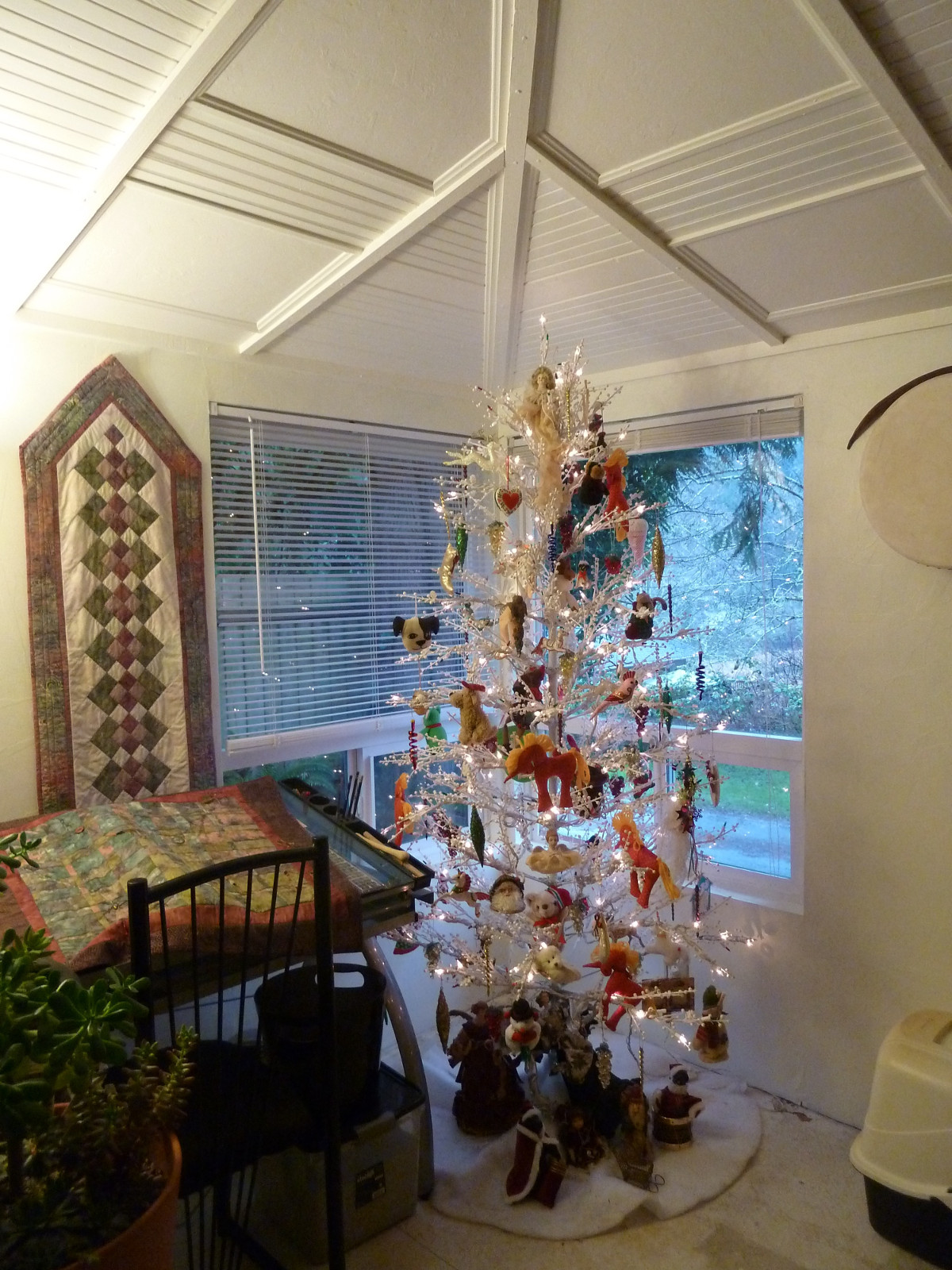
For most of my life I was adamant about having a real tree — preferably one I cut down myself. I was such a live-tree snob I wouldn’t even speak the words “artificial Christmas tree.” Instead, I’d call those abominations … other things I can’t type.
Then I spotted my present super-funky and super-fake tree half off at the local general store just after the *&^%$#@! federal government announced a tax on real Christmas trees. Remember that? Right before Christmas 2011? Right in the middle of the Great Recession?
I was so grossed out that I blogged about the tax not just once, not just twice (after the PR guy for the National Christmas Tree Association informed me the thing wasn’t a tax but merely a harmless little mandatory “checkoff”), but a third time after one of the tree farmers promoting the tax kindly gave me a long, detailed answer to my query. Our resident economics and market maven Silver, also added a strong rebuttal to the tree taxers. (You’ll find that linked from those 2011 posts, but I’m not sure the link to Silver’s fisking still works. It didn’t work for me when I prepped this post.)
Ever since then … no live trees for me. And that’s despite the fact that the Obama administration caught such hell (or rather because “right-wing bloggers inaccurately characterized the newly instituted checkoff as a Christmas tree tax”) that it took them another four years to impose what Snopes.com still insists is NOT a tax.
‘Cause, you know, even though the fedgov imposed it and even though unwilling tree farmers and ultimately their customers are forced to pay it, the money goes not to the Treasury, but to the Christmas tree growers who used their pull with the feds to force it on their less willing competitors. That doesn’t sound anything like a tax, now does it?
Funny how a $0.15 fee and a few pages of new regulations can still generate mental steam seven years later. But it’s not the money; in this case it actually is the principle of the thing — and the Orwellian BS about it being not-a-tax. Then, too, it was the final straw that prompted my favorite local Christmas tree grower close its operation.
Ahem. ‘Nuff of that. These days, there are wild varieties of funky, artsy, clever Christmas “trees” that look nothing like the plasticky faux-live or ghastly silver artificial trees of the past.
I’m happy with my resplendently, refulgently, candescently phony tree-in-a-box and glad to have it glowing again this year. Take that, you tree taxers!
—–
My ornaments are old friends, and are mostly stuffed animals. Or stuffed-non-animals. Or non-stuffed animals:
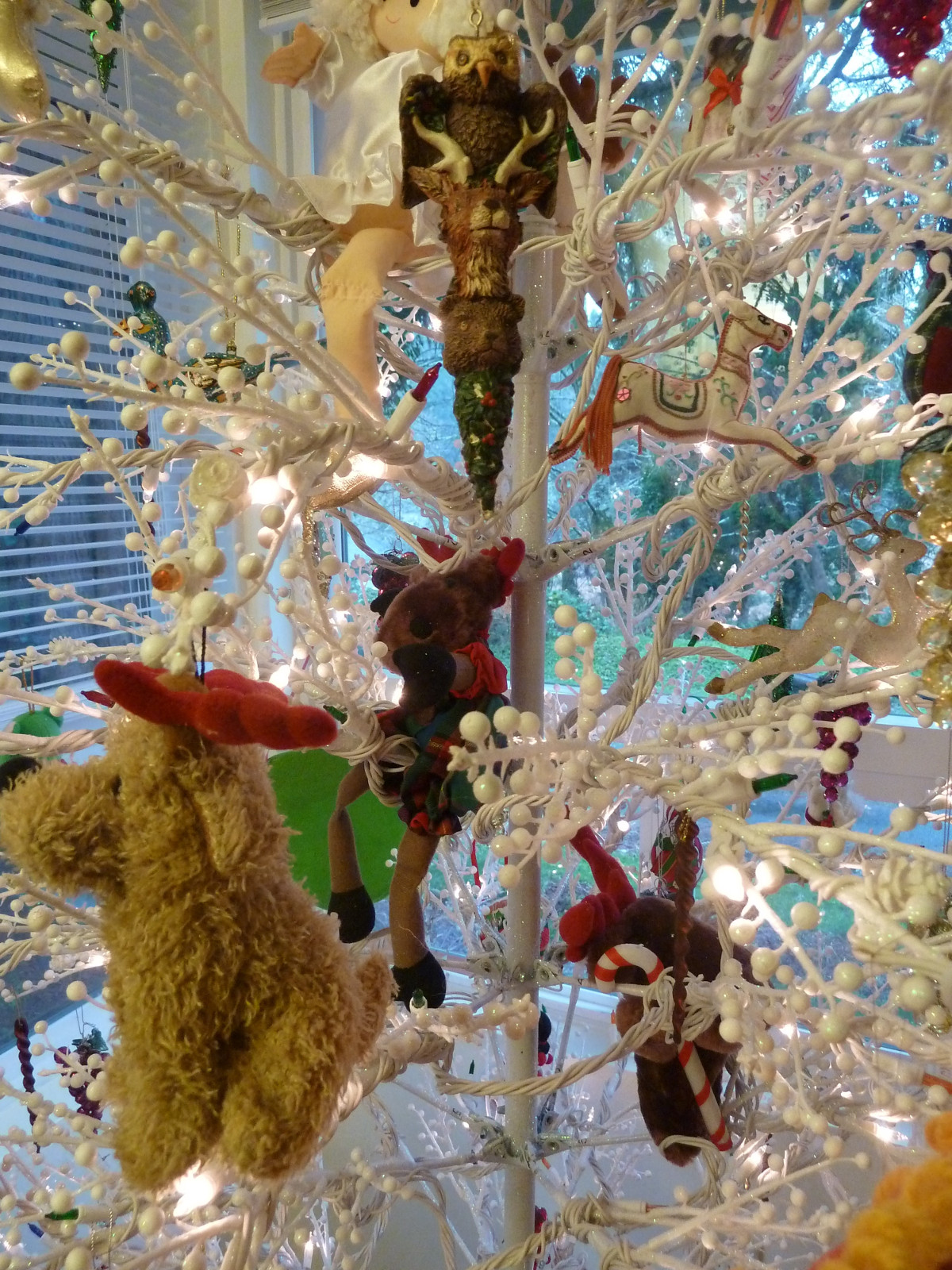
I try to buy a few new ornaments every year, but many of these guys are old friends. I’m glad to see them again.
OTOH, many are also from the 1980s — a decade that turned my life inside out and upside down and ended up shattering my most cherished concepts of relationships and reality. Those, perhaps I should burn come January. Seeing them again each Christmas reminds me of catastrophes I wish I could put away forever.
But seeing those ’80s ornaments again also delivers a good reminder never to get complacent. Reality can flip life on its head — boom. Then it’ll do it all over again — and again — knocking you hellishly back down every time your poor, afflicted self tries get to its feet. (Yeah, ceaselessly terrible times those were, though they eventually led me to empowering choices and a good life.)
So enjoy warm and happy times while you’ve got ’em. Cherish them, but never imagine you’re entitled to them or immune from the cruelest depredations of reality. Then, in terrible times, know that you can still rise and prevail no matter how relentlessly life is kicking and stomping on you at the moment.
But for now, I hope you’re all having a wonderful, disaster-free, and relatively tax-free, holiday season.
So the 80s ornaments are symbols of “That which does not kill us, makes us stronger.” 😉
May the funk be with you.
tax
noun
1. a sum of money demanded by a government for its support or for specific facilities or services, levied upon incomes, property, sales, etc.
2. a burdensome charge, obligation, duty, or demand.
Pretty, pretty, pretty!
You should take us all on a photo tour of your house sometime. I know you’re going to scoff modestly, but I think the corner you showed us looks positively elegant.
As for Christmas trees, they aren’t really supposed to be trees, necessarily, although one might choose to use an actual tree. My wife and I have always used an artificial one, simply because it is gratifying to our sense of thriftiness to re-use such a thing more or less indefinitely. The reason I claim it isn’t really a “tree” is that, when you’re done with it, it bears a lot of ornamentation that is certainly never seen in nature. So, it’s really the foundation of a work of decorative art. And yours is splendid!
I actually had a very similar tree and matching reindeer for outside for my yard at one time. Daughter 2 said alcohol must surely have been involved in the purchase decision, and threatened to shoot out the reindeer’s red eyes and nose.
Daughter 2 sounds like a fun person! (Always assuming she isn’t drawing a bead on your reindeer’s head.)
Donate the bad memory ornaments to someone who wouldn’t have the bad associations. Some of your readers might even be willing to buy one or two from you just to add a little Claire to their tree. For a yearly reminder of the value you’ve added to our lives. Even knowing the old ornaments have bad memories attached for you– it’s like the new owners would be saving you from having to look at them.
Your tree looks very nice.
I finally put up my tree today. Now I’ll see if the newest cat will let it survive the season.
I like your tree. It’s funky-cute and unique.
Good thoughts, all. And I can at least say that (LOL) no alcohol was involved in the purchase of my funky tree.
And Kent and Larry — I like your ways of looking at those bad-memory ornaments. Thank you.
I’m sorry not to get to this reply sooner, but I was minioning for The Wandering Monk all day, as tonight’s blog post shows.
I’m not much for Christmas trees but I always love a glimpse of that lovely eccentric ceiling.
I love that ceiling, too. But there’s about half that you don’t see that’s in another room, and that half I got stalled on several years ago. All it needs is finishing detail and painting. But even that’s so complex that every time I look at it I groan, “What on earth was I thinking when I started that project?”
The following is from Silver. This is the fisking he gave Betty Malone’s comments during the original 2011 tree tax controversy. Her claims are in quotes with his rebuttal between.
—–
The Silver economics blog was lost when Mises.org switched to a different forum. Now I don’t think there is any communitor forum at all.
The text below is what I have. I suspect I polished it a bit more before posting, but this is what I have left.
Merry Christmas!
—–
“We are primarily wholesalers, but have been retailers and now also have a small choose and cut operation.”
“A check-off is a program where commodity groups can help themselves to better their industry.”
No, a check-off is a government violent intervention in the marketplace wherein a few larger, well-connected firms can coerce smaller firms into paying for services they neither need nor desire.
“But by working together, the industries such as cotton, could pool their resources and speak with one voice.”
By employing government coercion and theft to steal funds from smaller producers, various industries were able to stifle discussion and dissent and force the views of a tiny minority of politically-connected producers onto a national stage that they were unwilling to pay for with their own money.
“The assessment that is made is self-imposed funding by the industry itself to help itself.”
There are over 13,000 Christmas tree operations listed in the latest USDA census. Less than 500 commented on the proposed rule. There is no evidence, nothing at all, to suggest that this tax was self-imposed. Instead, the evidence is clear: the assessment is conceived and imposed by a tiny minority of larger players and politically connected parasites on an overwhelming majority of smaller producers.
“The monies are collected, the program designed and run by an industry board.”
This is a flat-out lie. The text implies that the monies are collected by an industry board. That is utterly false. The monies are collected as part of tax filings, under the pains of persecution. All the tools of government: the club, the cage, the gun, the noose, the midnight raid, the torture devices, all of them are employed to collect these monies.
“Taxes are monies collected by the government for use by the government. Monies collected by check-offs go directly to the check-off to be used for research and promotion for that industry alone. “
This is another lie. Ms. Malone creates a new definition of taxation in order to evade responsibility for her very personal role in stealing money from unwilling competitors. She cites no source for this comforting lie, she makes it up.
The Wikipedia entry for tax quotes from Black’s Law Dictionary:
A tax may be defined as a “pecuniary burden laid upon individuals or property owners to support the government […] a payment exacted by legislative authority.” A tax “is not a voluntary payment or donation, but an enforced contribution, exacted pursuant to legislative authority” and is “any contribution imposed by government […] whether under the name of toll, tribute, tallage, gabel, impost, duty, custom, excise, subsidy, aid, supply, or other name.” That list of names includes “checkoff.”
“We petitioned the USDA as is our right under the First Amendment to the Constitution. “
You did no such thing. As your later testimony demonstrates, you took advantage of an existing law passed without your knowledge or approval. You and a small cabal of morally challenged people spent years studying how well this law had been used to mulct other small producers in other industries. You decided you wanted in on the act. You wanted other people to fund your advertising budgets, and this law looked like the perfect way to screw the rubes.
“We asked them to allow us to create a program that they would then provide the oversight, that the industry pays for.”
You asked nothing. You followed the rules and procedures established by the earlier bands of thieves who had taken advantage of this opportunity to steal.
“It is revenue neutral to the government.”
Prove it. Prove to me that the government is capable of tracking the costs associated with collecting your advertising funds via taxation. Prove to me that they can account for the costs of persecuting those who don’t file the right forms, or make trivial mistakes. Prove that all of the administrators, secretaries, liaisons, regulators, overseers, auditors, PR specialists, and other parasites charge the full costs of their efforts.
You can’t. You have never even tried. You are merely parroting what some self-interested government bureaucrat told you. Prove me wrong.
“The government doesn’t get any of the money, but the industry has to pay for the oversight.”
Another damned lie. The government gets ALL the money. Then they give some of it to the small gang of thieves Ms. Malone calls “the industry.” “Pay for oversight” is how thieves describe the process of divvying up the loot amongst themselves.
“It is a serious thing we were asking.”
Stealing money from small farmers is a serious thing indeed.
“The check-off boards must set goals to be met by the program. Every 5 or so years an econometric study must be done that tells whether or not those goals are met. If those goals are not met, the program folds.”
Translation: We steal the money, we make up some nonsense about what we plan to do with it, we set low-ball goals that anyone could meet, then every 5 years we pay still more stolen money to an “economist” who knows that if they don’t sign off, their gravy train will end.
“The USDA makes sure that money is used for what it is supposed to be used for.”
“Supposed to be used for” according to whom? The enormous majority of small producers who are the unwilling victims of this theft had plans for their money before Ms. Malone and her co-conspirators stole it. The USDA at best can only try to ensure that the thieves use the loop as they promised. Given how well government is run in every single other instance, taking this statement at face value requires enormous naiveté.
“A group of us growers and importers started 3.5 years ago in April of 2008 to study other commodities that have tried these programs. We focused on commodities that were similar in size: blueberries, mangoes, watermelons, sorghum and several others. We conducted facilitated sessions in the four top growing areas of the country. By now there have been at least 100 meetings across the country at state and national Christmas tree meetings discussing the check-off. “
How many of the 13,000 plus operations participated in these meetings? What does “facilitated meeting” mean? In my experience, a facilitated meeting is a carefully scripted bit of theatre designed to convince the gullible that a democratic process is being followed. In reality the outcome is pre-determined and the purpose of the facilitator is to stifle dissent and marginalize opposing points of view. Prove me wrong.
“You asked how we can guarantee that the assessment would not be passed on to the consumer. We can’t guarantee that. Each grower will make that decision.”
If they are allowed to make that decision, why can’t you allow them to make the decision to contribute or not?
ANSWER THE QUESTION. Why did you feel it necessary to resort to coercion and violence to achieve your goals? Why have you not answered Claire’s initial question:
“If this is really something the farmers themselves want, then why don’t they just band together and do it? Why involve the government?”
“Farmers know dirt. We know how to grow things. But in this changing world is it not enough to grow a great product. We have to let people know about our product. That takes time, coordination and money.”
It has always been so, and not just for farmers. All businesses have to promote their products. Until the National Christmas Tree Association conspired to steal from thousands of small producers, those decisions were left to each farmer. No longer.
“Nothing prevents farmers from pooling their resources without the USDA.”
So why not do it?
“In the last 20 years there have two very strong voluntary programs initiated by the industry that raised nearly a million dollars each. We have found, as every industry we studied found, that voluntary programs have a life of about 3 years. The volunteers running the program and paying into the program burn out. Everyone in the industry benefits, but only a few carry the burden. These two programs had great impact on our industry’s ability to promote our product.”
So rather than learn from your past experiences and develop new, better programs, you elected to go the easy route: theft and coercion.
“We know promotion and research work.”
All of the material in evidence suggests otherwise. I never heard of the National Christmas Tree Association until this week. Now I will never forget them. I will make sure than not one thin dime of my money ever goes to any grower connected in any way with this corrupt gang of unrepentant thieves. Thieves so clueless about promotion that they rushed a new tax into being during the worst recession in at least 60 years. People so arrogant that they think they can spout a bunch of bilge about taxes not being taxes and expect people to believe it. People so completely stupid that they can actually give Christmas Trees a bad name.
“We have to do it as an industry to survive.”
That’s your opinion, unsupported by any evidence.
“A check-off is fair,” a lie
“equitable” a damned lie
“and can supply sustainable monies.” I just threw up in my mouth. Malone thinks stealing is sustainable. She thinks government is forever. She figures that once that the gravy train is rolling, it will never stop.
Good luck with that. Let me know how it works out. On second thought, don’t bother. I don’t associate with people who use violence and theft to advance their personal goals. I frankly don’t give a damn how this works out; all I know is I will never buy another live Christmas tree again.
I usually get a potted rosemary for a Christmas tree, and try to keep it alive long enough to plant it in the spring. I keep hoping that eventually, they’ll either reseed themselves, or else develop enough cold tolerance to survive the winter, and then I won’t ever have to buy rosemary again.
It’s one of the few plants I don’t have much luck with.
Potted rosemary. Neat idea. It’s too bad you can’t keep one alive in your climate.
I’m planning an herb garden for next year and rosemary will definitely be included. It’s not only one of my favorite herbs, but I hear it loves the PNW climate. Furrydoc has several large rosemary plants in her yard that began life in tiny little 4″ pots from the general store and are just growing wild without much attention.
I had a potted rosemary a few years ago that lived on my uncovered back porch for five years, even through snow (which insulated it).
You can also cover the main root system with a plastic garbage bag (with holes in it for “breathing”) during the winter in an area protected from wind, and it will revive in the spring.
It doesn’t take soil amendments very well.